
The Philosopher's Shadow
You're looking in the wrong cave for the gold, kids.

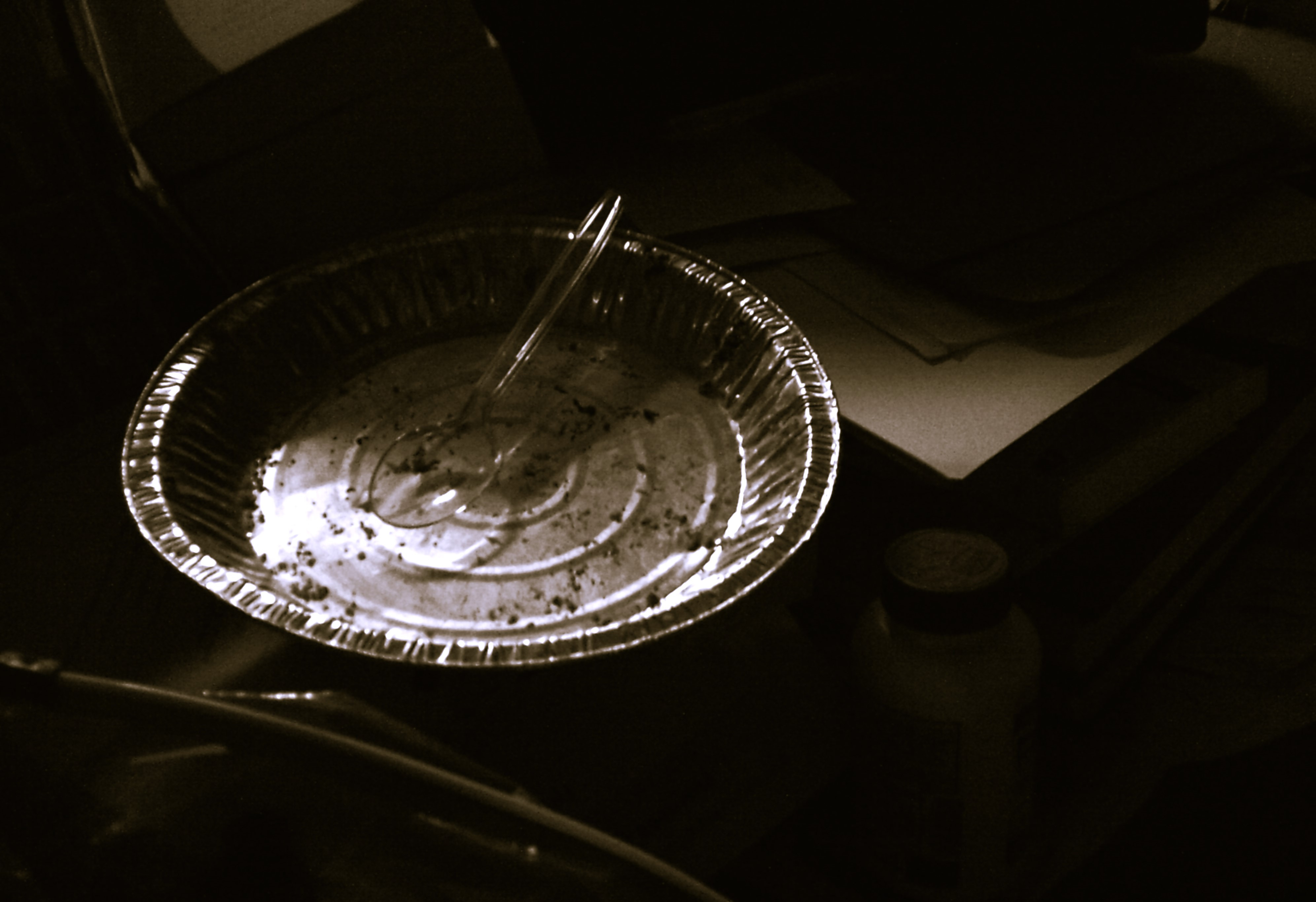
Untitled random photograph Number 5,783. 26 November 2024, Richard Van Ingram. (Possible symbolic value present at no extra cost.)
“The sound of people getting drunk
A ceiling and a sky
A bank that's full of promises
A telephone that lies
A visit from your doctor
He crawls in through the door
A mirror you can look in
So that you know where you are
”You didn't leave me anything
That I can understand…
Now I'm left with all of this
A roomful of your trash”
from ALL OF THIS AND NOTHING
The Psychedelic Furs
TALK, TALK, TALK (1981)
”My formula for greatness in man is! amor fati: the fact that a man wishes nothing to be different, either in front of him or behind him, or for all eternity. Not only must the necessary be borne, and on no account concealed,—all idealism is falsehood in the face of necessity,—but it must also be loved....”
Friedrich Nietzsche
from Part 10, “Why I Am So Clever”
Ecce Homo
*******************************************************************************************************
Amor Fati: Love your fate. Embrace your fate. Lean in to your fate.
On a different day, in other circumstances, I might recommend this attitude to you, or already may have done so — it can be helpful when meaningful, for those who can grasp the value of this motto.
But not today. Not so simply, at any rate.
***
As a philosopher — well, I have a graduate degree and decades of reading, writing, and worrying over the subject; worse, I’ve lived it, converted ethical theories into vital beliefs I rely on for guidance in everyday life, for better and worse. Again, as a philosopher, it is disconcerting to look on the internet and see so many others either claiming the shabby mantle of the philosopher or freely mouthing the words of philosophers.
Philosophy is normally not a popular thing: one pursues wisdom, never catches her, and is repaid, more often than not, with the disdain of one’s fellows. Advertising one’s philosophical leanings is very close to flashing a calling card with your name above the word “Unemployable.”
Generally, careers calling for formal training in the subject are in the field of education, often university level, and many of these positions are impermanent, without benefits, and pay about as much as working third shift at a decent gas station except the task is far more difficult.
Yet, maybe because the word “philosophy” still suggests gravity, weight, depth, a mysterious seriousness, some are drawn to use it online. Of what claim to maturity those employing the term may have, I rarely know. This, mostly because I lack the time or patience to wade through their multitudinous blogs and Substacks and newsletters and Youtube channels. Nevertheless, there they are.
Are these messengers and their vehicles filled to the brim with sincerity, much less truth and accuracy? Are they of goodwill and right intention? I do not know, nor do I claim such understanding. Nor do I dissuade them in their pursuits if, indeed, they are chasing Wisdom.
Simply, it is the sheer number of such people claiming to practice philosophy online that catches my breath. Some of it is bound to be simply repetition of material taken, without any sincere examination, from other sources, cited or uncited.
Some of those sources, I fear, may appeal to the internet thinker solely because of the aesthetics, the music of the ideas, not the truth, the goodness, not the meaning of the ideas. So those ideas are repeated simply because, as people say where I come from, they sound “Big.” Association with the concept seems to inflate the ego or reputation of the user; it imparts a sort of virtual mental and emotional toughness — if not physical invulnerability unavailable to average human beings.
Amor Fati has become, I fear, one such concept.
Not only accept the reality thrust upon one, the reality one finds oneself within, but one must, as Nietzsche says, love it. Embrace it with both arms. Rejoice in it.
Nietzsche is, as he often does when he is at his best, quoting the Stoic philosophers, Stoic ideas, and breathing new life into them. Nietzsche knew what he was doing and why.
Those wildly quoting him all over the internet using that Project Guttenberg edition of ECCE HOMO I used above — not, say, the Walter Kaufmann translations — is telling: these internet sites are quoting one another and cannot actually tell anyone where, precisely, to locate the quote. Nor have most of these folks actually read Nietzsche, much less ECCE HOMO; fewer understand him, I’ll warrant. If they did, someone might be tempted to recognize the obvious humor, potentially blasphemous to Christians but humorous, nonetheless, in Nietzsche calling his brief autobiography ECCE HOMO.
It should also put the reader on his toes, this trickster Nietzsche humorously appropriating a serious Gospel passage, who also appropriates Stoic ideas. Does he mean exactly what Stoics meant when they recommended that one should “love your fate”? And when he goes further to tie this concept to what he calls the “Eternal Recurrence,” do those online lovers of philosophical quotes grasp he has revived the Stoic hypothesis that time is circular, running through exactly the same events forever? So that what one chooses, one chooses to repeat again and again through all eternity — thus one ought recognize the seriousness of all one’s choices?
Or does it all just sound Big? Is all this quoting and revival simply granting those doing the talking a pedigree they may not themselves take seriously and uphold in offline life? In other words, do these people live up to what they are invoking? Have they given any of this genuine thought?
Epictetus, the first century c.e. Stoic, taught:
”Stored things may be available for you to bring out and show whenever you want, but they don’t do you any good at all except insofar as you gain a reputation for having them. What difference does it make if you expound these teachings or those of another school? Sit down and give a theoretical account of Epicurus’s teachings; you’ll probably come up with a more user-friendly version than he did! Why call yourself a Stoic, then? Why mislead the public?”1
******
Let’s consider for a moment the concept of fate.
Without an in-depth examination of the concepts of fate and fatalism, which I don’t see as necessary here, let’s be content to say that fate is simply what is outside one’s complete control. It is the given, what one is handed, what one is born into, what one has no choice about.
For example, I have no choice about who my biological parents may have been and the genes I inherited. I have no choice about the material and economic conditions within which I was raised. I have no choice about the dominant cultural beliefs I was initially told were right and good and necessary — nor have I any choice about which of those beliefs were fictions and which bore some degree of truth, no matter how sincerely held.
I have no choice about the time and place in history I was born, which planet, which nation, what political system, what were the dominant religious beliefs, if any; I have no choice about my native language and how it was constructed.
I have no choice about anything we call “nature” and its behavior, tendencies, and all the things we study by means of the various sciences. My body and its structures and defects were given to me without my consent as was my psyche — my soul — and its structures and possible defects and limitations.
I had no choice about being born: it happened to me, just as, at some moment, death will happen and end my presence here.
I have no choice about the fact that I was born with the power of choice and the need to exercise what little of it I have - since a human’s life is not entirely automatic or guaranteed to unfold without effort and personal care.
I have no choice about my needs as a human and I have no choice about what needs I must strive to meet in order to become an approximation of a good human, someone good at being a human, and also good at being the particular human I must become.
20th c. Spanish philosopher Jose Ortega y Gasset put much of this in, perhaps, better language: “I am I plus my circumstances.” That which surrounds me in my life is what we are calling “fate”; but the term “circumstances” lacks the possible connotation that my fate was intended by some higher being, G-d. Perhaps it was in some meaningful sense, but no philosopher should assert that - as a philosopher - until introducing good reason to believe it. Presently, we lack such reasons (whether or not I or you may believe it as a matter of religious faith), so we need not introduce that complication. “My circumstances” are a fact of my living - that about which I must constantly make decisions.
The first “I” in Ortega’s formulation is the “I” who is the ongoing outcome of my choices, my values, and the quality of both. The circumstances are what is given, what is “there,” in some sense, which assists and resists my plans, my choices, the destiny I must choose from the few on offer in order to attempt to become that person — my vocation… myself.
Part of my circumstance is other people. People who are immediately apparent and the people I learn about second hand, through media, through literature, through rumor. My fate, then, is entangled with your fate, the fate of others - innumerable others; perhaps all others who are my contemporaries, known and unknown.
I do not appear alone; and the others do not appear without me. Nor do their circumstances appear without me and my circumstances.
Of course, the circumstances of others are part of my own, too. If I am to “love my fate,” I must also embrace the fate of others, whatever those fates may be. I must will their circumstances even as I will - demand, embrace, revel in - my own. Again:
”My formula for greatness in man is! amor fati: the fact that a man wishes nothing to be different, either in front of him or behind him, or for all eternity. Not only must the necessary be borne, and on no account concealed,—all idealism is falsehood in the face of necessity,—but it must also be loved....”2
I should wish nothing to be different? Really?
Nietzsche, I take at his word here. What he means may not, probably does not include the difficulty I have revealed in taking amor fati with utter seriousness. He embraced and loved his own fate, what had been thrust upon him personally with which to deal and what he had made of that. It’s the undercurrent in all his writing. The man was not granted an easy life — read some of Robert Solomon’s commentaries or lectures on the subject for some insight; yet, out of the lack of ease he forged himself and his questions, “questionable questions,” as I recall he half humorously implies somewhere.
As hard as his life had been, inside four weeks of Ecce Homo going to press, Nietzsche suffered a mental breakdown from which he would not recover. That, along with his reputation. Some scholars still dismiss his later works, especially this one, as showing the signs of having emerged from insanity. (Myself, I would say what truth there is in the writing is the issue, not whether the writer suffered a disease about which many ignorant people, even with weighty pedigrees, maintain prejudices no better than the average ditch digger’s.)
His proto - and later fully Nazi sister took control of his literary estate, edited, and rewrote his works to sound as if Nietzsche — the anti-German Nationalist, the opponent of antisemitism, the man who disowned his sister for her marriage to the proto-Nazi Paul Förster — was, himself, a prophet of the Hitlerites.3 Her acts and forgeries ruined or obscured an accurate evaluation of Nietzsche’s thought and work until after World War II.
This, too, was Niezsche’s fate, the one he exclaimed he wholeheartedly embraced, not knowing his own future. Who can know what will happen to us? Fate and fortune can be - are - blindly cruel.
Again, Nietzsche I take at his word. He meant what he said. He loved and lived out his fate to the last bitter moments long after he lost any choice in the matter.
I do not know that he took into account the fates — the circumstances — of others, the ones that made up a fair portion of his own circumstances, his own fate. The fact that he did not spend a great deal of time considering the issue suggests to me, not oversight or ignorance - G-d forbid in his case - but that his definition of the “fate” he was willing to love did not include the fates of others. It was his own imposed fate converted into a personal destiny by choosing it, by seizing it from the impersonal, blind forces that forced it on him, thereby transforming it into something he voluntarily chose for himself and from which he made a life, his life.
We see the same maneuver executed more explicitly and beautifully in Albert Camus’ essay The Myth of Sisyphus; instead of the embarrassing infernal recurrence of the mere words ”amor fati” minus a depth of insight online, I would send you to Camus who simply shows you a meaning, a how, and a why of this teaching.4
**************
Return for a moment to the problem I raised: My circumstance entails yours; yours entails mine. We are all entangled. If I am to even superficially “love my fate,” again, I must also love yours, whatever it may be.
The suspicion I have is many repeating these words and playing loosely with the concept don’t take it seriously, deadly seriously. They are not truly wrestling with attempting to live it, to make their lives and this love one and the same event. Perhaps it fills space on internet websites of a certain sort or appeals, in a vague way, to people searching for meaning in this massive car wreck of civilizational crisis.
Either way, think about what you are saying. Take it very seriously — there is a valuable teaching here from which to mine something of human value. But, as with many things, the teaching has its shadow, its misleading imitation of no substance and much possible harm.
I have to admit immediately, if amor fati demands that I also love, indiscriminately, what has been handed to others to endure, I can have nothing to do with that interpretation. Your circumstances are entangled in mine, mine in yours — I cannot “choose” mine wholeheartedly if you must pay the price for my chosen destiny. I will not.
Follow along:
As a child, I loved a girl intensely. She was very important to me. As we grew older, she revealed that her father was molesting her — her father, pillar of the community, respected professor. Probably, he was molesting his other children as well. Decades later, I found he molested other girls outside the family who came to sleepovers at my friend’s. All kept this a secret, never to be admitted and spoken of; all were horribly damaged by this man who died eventually, in retirement, well honored and with his good name intact.
We lived at a time and in a place where anything I or anyone else might have said would not have been believed.
Later, I found many — many — of the young women I went to school with or knew later had been molested or raped as young girls, exposed to things that were traumatic, damaging. The rates and types of child abuse in my community alone were staggering… yet, at the time, all children of whatever age believed they were alone and went on to silently carry the scars and damage, to ignore it, to deny it.
My grandfathers fought in World War II. Both saw and participated in horrific things and returned damaged — though no one cared. PTSD was not even a psychological concept in the 1940s. My mother and father were damaged by their fathers — and their nightmare mothers were of no help, to say the least. In turn, over time, these experiences warped my parents so that, when they had children, they had no real idea what to do with us except, to a degree, perpetuate the violence and neglect they knew; except each did this in their own way. My parents’ sanity was questionable: my mother, after abandoning me for about a year, returned after a failed suicide attempt and, inside about a week, tried to kill me while I was getting ready for school — maybe I was 12.
She wound up hospitalized for weeks and after that it was never to be spoken of, any of it. And she remained violent and verbally horrific, mainly towards me as I was the eldest and male, I suppose. My father worked as much as possible to avoid home and, when he did come in, often the first thing to happen was my mother demanded he beat me. This went on for some time and damaged my parents and my sister as much as it damaged me. Maybe more so. No one does such things to others without deepening their own wounds, damaging their own souls, their own minds.
At a time when I drove the van for a public mental heath adult day program, there were two of our people who fell in love. Older than me, they married and sat, as I recall, many days out in the afternoon sun holding hands. Their courtship was pleasant, even innocent. The gentleman’s diagnosis was schizophrenia, though he was stable — he didn’t talk much, but he had his own truck and did things. I never knew his wife’s diagnosis, but at that time she was doing well.
One weekend, the gentleman, without a word or a note or a hint anything was wrong, drove himself to a state park next to the lake and hung himself from a tree with his belt, I believe. Out of nowhere. Who knows what came over him or how long he silently wrestled with that impulse.
His wife fell into one of the blackest depressions I’ve witnessed. I went each morning to pick her up for the day program and she came staggering out crying. Her elderly mother had to dress her each day and make her leave the house. The woman would then cry all day, unable to speak, her eyes swollen, miserable, searching from face to face for some sort of… what? Relief? This went on for at least a month, I think. Once, I sat next to her and she just put her head on my shoulder and wept; my shirt was soaked with her tears and I sat helpless, though I’d have done damn near anything if it could have bought that woman an hour of peace.
Eventually, she was sent to the state mental hospital where, after many attempts at medication changes, they resorted to rounds of Electroconvulsive Therapy (ECT). This achieved the aim, though she lost some memory. After she returned, she went through her days quietly, tearlessly as before, without her husband or a mention he’d ever existed.
I had a friend who, after he did 20 years of a successful career in the Navy, returned home and, over a few years, increasingly isolated himself from everyone. His brother went by one day because he wouldn’t pick up the phone — he’d killed himself with a shotgun. This man who wanted to be an artist, a painter succumbed to a depression he did not discuss and for which he sought no help after a vibrant, meaningful life that quietly faded off into the black.
Now, do I choose to love the fate that includes these few examples? — I’ve many, many more. Do I love a fate that includes children in Gaza shot in the head by sniper drones; Jewish women brutally raped on camera 7 October 2023, kidnapped, then murdered? Do I love a fate in which innocent people in a Ukrainian rehabilitation facility are destroyed by a Russian hypersonic missile tested in the urban battlefield by a tyrant?
No, if amor fati involves my approval of, my love for any of this — these people and events in my own circumstances: no. No thank you. My task would seem more like Job’s: to argue with G-d that all of this is hellishly wrong, unjust, merciless, and often unbearable. And my days are better spent attempting to teach others to do differently, to seek better lives, to try to make small repairs while I, myself, do the same.
Not so Big this version of destiny, is it? Yet I sincerely find it better in the face of the world in which I live together with people who deserve so much better than they have received at the hands of others. My own hands must attempt to offer justice and mercy, as small as my work may be, to begin to show care where the rest of the world is given to carelessness.
That I may do this, I embrace my own fate, only my own fate, the part of it that has allowed me to wrestle my way towards a destiny better than the circumstances I was handed seemed to demand of me. I do not love my fate — I accept it, so I may do battle with some parts of it. If I do not face it, I will merely deny and hide from reality, which will not do me or others any good.
And if philosophy as a lived vocation isn’t for doing good, seeking good, there is ultimately little point in it aside from empty slogans, endlessly repeated.
28 November 2024
Gershom
Richard Van Ingram
Epictetus: The Complete Works; pg. 159; Discourses, Book 2.9, sections 18-19; translated by Robin Waterfield; The University of Chicago Press; copyright 2022 by Robin Waterfield; ISBN-13: 978-0-226-76947-9
Ecce Homo (Nietzsche’s Autobiography); pg. 54, section 10 of “Why I Am So Clever,” around the final two sentences; translated by Anthony M. Ludovici; T.N. Foulis, 13 & 15 Frederick Street, Edinburgh: and London, 1911; https://www.gutenberg.org/files/52190/52190-h/52190-h.htm
https://www.britannica.com/biography/Elisabeth-Forster-Nietzsche
“It happens as well that the feeling of the absurd springs from happiness. “I conclude that all is well,” says OEdipus, and that remark is sacred. It echoes in the wild and limited universe of man. It teaches that all is not, has not been, exhausted. It drives out of this world a god who had come into it with dissatisfaction and a preference for futile sufferings. It makes of fate a human matter, which must be settled among men.
”All Sisyphus’ silent joy is contained therein. His fate belongs to him. His rock is his thing. Likewise, the absurd man, when he contemplates his torment, silences all the idols. In the universe suddenly restored to its silence, the myriad wondering little voices of the earth rise up. Unconscious, secret calls, invitations from all the faces, they are the necessary reverse and price of victory. There is no sun without shadow, and it is es-sential to know the night. The absurd man says yes and his effort will henceforth be unceasing. If there is a personal fate, there is no higher destiny, or at least there is but one which he concludes is inevitable and despicable. For the rest, he knows himself to be the master of his days. At that subtle moment when man glances backward over his life, Sisyphus returning toward his rock, in that slight pivoting he contemplates that series of unrelated actions which becomes his fate, created by him, combined under his memory’s eye and soon sealed by his death. Thus, convinced of the wholly human origin of all that is human, a blind man eager to see who knows that the night has no end, he is still on the go. The rock is still rolling. I leave Sisyphus at the foot of the mountain! One always finds one’s burden again. But Sisyphus teaches the higher fidelity that negates the gods and raises rocks. He too concludes that all is well. This universe henceforth without a master seems to him neither sterile nor futile. Each atom of that stone, each mineral flake of that night-filled mountain, in itself forms a world. The struggle itself toward the heights is enough to fill a man’s heart. One must imagine Sisyphus happy.”
The Myth of Sisyphus and Other Essays
pages 77-78
Albert Camus
Translated from the French by Justin O’Brien
1955